


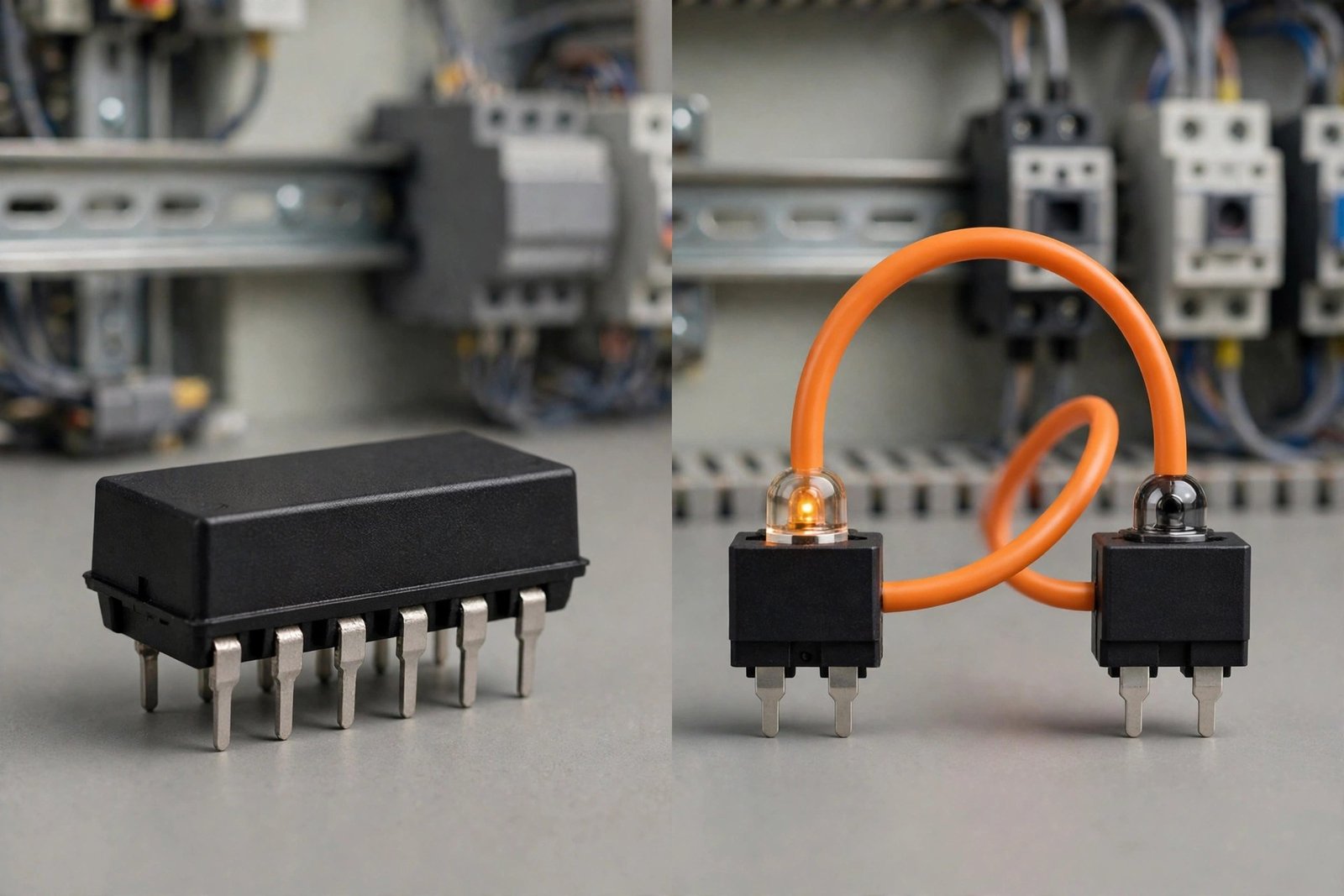
Short answer first. A photocoupler puts an LED and a photodetector in one package so a signal can cross from one circuit to another without any copper between them. TOSLINK does the same job, except the LED and the detector are no longer in the same package. They sit in separate modules, sometimes a kilometre apart, and a fiber optic cable carries the light between them. Same idea, stretched out. Toshiba’s own manual calls it exactly that: a long-distance photocoupler.
That one sentence explains most of what TOSLINK is good for. Wherever you would use a photocoupler for isolation — between a noisy drive and a quiet controller, between two boards at different ground potentials — a TOSLINK link does the same thing over real distance, with the same electrical separation.
The fiber is just a light pipe — but a fussy one
Light stays inside the fiber by total internal reflection. The core has a higher refractive index than the cladding, so light hitting the boundary at a shallow angle bounces back in instead of leaking out. Bend the fiber too hard and the angle changes; light escapes, and the link loses power. Toshiba’s rule is plain: keep the installed bend radius at 6 to 10 times the fiber’s minimum, and pull the connector when you unplug, never the cord.
Toshiba sorts its fibers by distance, not by brand. All-plastic fiber (APF) is the short-distance fiber. Plastic-clad silica (PCF) is the middle one. Silica fiber is the long-distance one. The general-purpose 190 series modules run up to 6 or 8 Mb/s and reach 1,000 m on PCF, but only 40 m on APF. Same modules, same LED, same detector — the fiber decides the ceiling.
That is the first thing to get straight when someone quotes a distance for a TOSLINK link. The number belongs to a system — modules plus fiber plus data rate — not to the cable alone.
The transmitter: a differential LED drive
The transmitter is an LED, but it is not switched the way a panel indicator is. Toshiba drives it from a differential circuit, so switching the LED on and off barely moves the supply current. That matters in a cabinet full of drives and inverters, because a transmitter that yanks its own supply rail every bit would inject noise into the very circuit it is supposed to isolate.
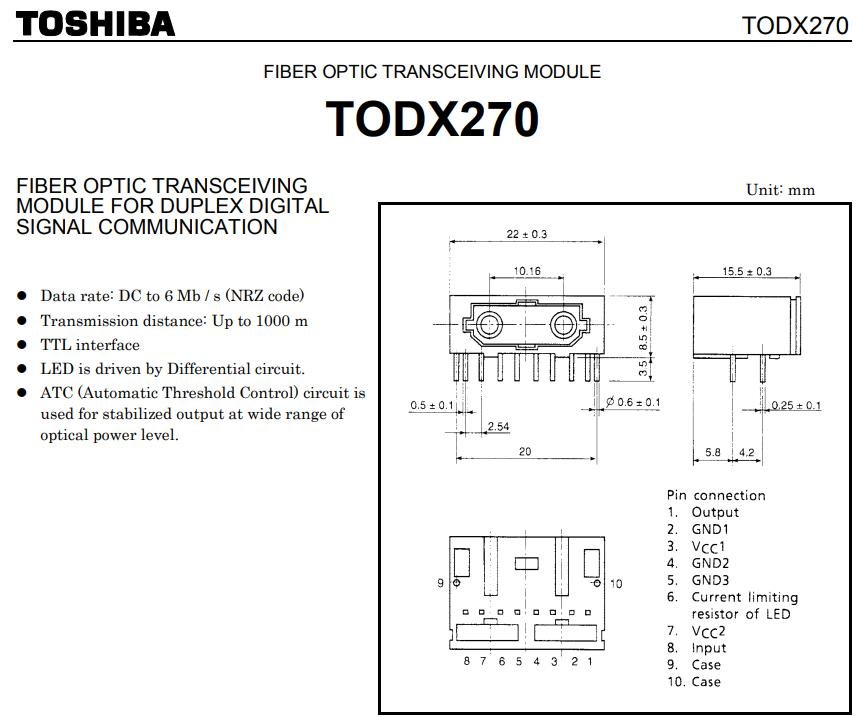
The application circuit gives you one knob to turn: the LED drive resistor, chosen by distance and cable type. On a TODX270 duplex transceiver with TOCP200Q/X PCF cable, Toshiba’s table says 5.1 kΩ for 0.2 to 350 m, 2.2 kΩ for 350 to 700 m, and 510 Ω for 700 to 1,000 m. Shorter link, less light needed; longer link, drive it harder. With Sumitomo CF-2071 H-PCF the bands are 5.1 kΩ, 2.4 kΩ and 1 kΩ up to 800 m. Pick the resistor from the table, not from habit — it is the cheapest loss budget you will ever buy.
The receiver: ATC does the quiet work
The receiver’s problem is the opposite of the transmitter’s. The light arriving at the far end is never the same twice. A longer fiber, a tighter bend, a colder morning, an LED that has aged — all of them change how much light lands on the detector.
Toshiba’s answer is ATC, automatic threshold control. The receiver watches the incoming optical power and moves the comparator’s reference level to match it. The result is that pulse-width distortion stays small even as the received power wanders. On the TODX270 the figure is ±55 ns at 6 Mb/s. On the ceramic PN module TODX283, built for speed rather than distance, it is under ±7 ns at up to 50 Mb/s — but that module only reaches 10 m on APF and 100 m on PCF. Speed and distance trade against each other, and the receiver is where the trade shows up.
This is also why a TOSLINK link does not behave like a photocoupler that slowly goes deaf. As the LED ages — and Toshiba is blunt that LED output degradation is the main ageing mechanism in these links — the ATC keeps the output readable for longer than a fixed-threshold receiver would. Ageing still sets the service life, and a link that used to run with margin will eventually run out of it. A loss test after assembly, and again when a link starts acting up, is standard practice, not paranoia.
One link, three speeds
It helps to see the range on one page, because TOSLINK is not one product. It is a family that spans three orders of magnitude in speed:
| Module family | Data rate | Distance (APF / PCF) |
|---|---|---|
| 190 series, general purpose | up to 6–8 Mb/s | 40 m / 1,000 m |
| TODX283, ceramic PN | DC to 50 Mb/s | 10 m / 100 m |
| Digital audio TOTX/TORX141 | up to 15 Mb/s | 5 m (audio) |
| OFL TOTX1500/TORX1500 | 20–125 Mb/s | 3 cm — no fiber at all |
That last row is the photocoupler coming full circle. The OFL modules are a TOSLINK link shrunk back down to 3 cm of free space — an optical link for docking a camera or a PDA, where even a connector is too much hardware. Same principle, both extremes.
Two practical notes from the manual. First, the package matters: molded resin is the general-purpose housing; the ceramic hermetically sealed version handles humidity and temperature better, and Toshiba specifically recommends ceramic where red-LED modules lose output in damp air. Second, the audio numbers are modest on purpose. A digital-audio TOSLINK link runs up to 15 Mb/s over 5 m — plenty for 96 kHz DVD audio, and a long way from the triple-digit figures you sometimes see in cable marketing. If a number looks too good for a 650 nm LED link, check it against the module datasheet before repeating it.
Where these links actually live
The manual’s application list reads like a tour of a factory: factory automation, office automation, PC audio, digital audio, car audio and navigation, IEEE1394 optical links, DV cameras and PDA docking. The common thread is not speed. It is isolation plus distance.
A servo drive link inside one machine is the classic case — the same job a board-level photocoupler does, except the controller and the drive are metres apart and the cabinet is electrically filthy. A TOSLINK link crosses that gap with no copper, no ground loop, and no radiated noise picked up along the way. Between buildings, the same link runs 1,000 m on PCF and still has no conductive path for lightning or fault current to follow.
That is the test to apply when someone asks whether TOSLINK fits their job. If the answer would be “a photocoupler, if only it reached” — then a TOSLINK link is probably the right shape for it.
FAQ
Is TOSLINK really a photocoupler?
In function, yes. A photocoupler moves a signal across an isolation barrier as light; TOSLINK moves it across the same kind of barrier, except the emitter and detector are in separate modules joined by fiber. Toshiba’s manual describes it as a long-distance photocoupler.
How far can a TOSLINK link go?
Up to 1,000 m with PCF cable on the general-purpose 190 series or the TODX270 transceiver; 800 m on Sumitomo CF-2071 H-PCF. On all-plastic fiber the same modules reach about 40 m. The figure always depends on the modules, the fiber, and the data rate together.
Why does the receiver need automatic threshold control?
Because the received light level changes with fiber length, bending, temperature, and LED ageing. ATC moves the comparator reference to follow the incoming power, so pulse-width distortion stays small instead of growing as the link degrades.
How do I choose the LED drive resistor?
From Toshiba’s distance table for your cable: for TOCP200Q/X, 5.1 kΩ up to 350 m, 2.2 kΩ to 700 m, 510 Ω to 1,000 m; for CF-2071, 5.1 kΩ, 2.4 kΩ and 1 kΩ in bands up to 800 m. Longer link, lower resistor, more light.
JS TECH manufactures TOCP and H-PCF cable assemblies in Changzhou, including TOCP200 POF assemblies and CF-2071 H-PCF patch cords, in standard and custom lengths. Send your link distance and module model to sales@fevelectronics.com and we will confirm which fiber your link budget needs.
