


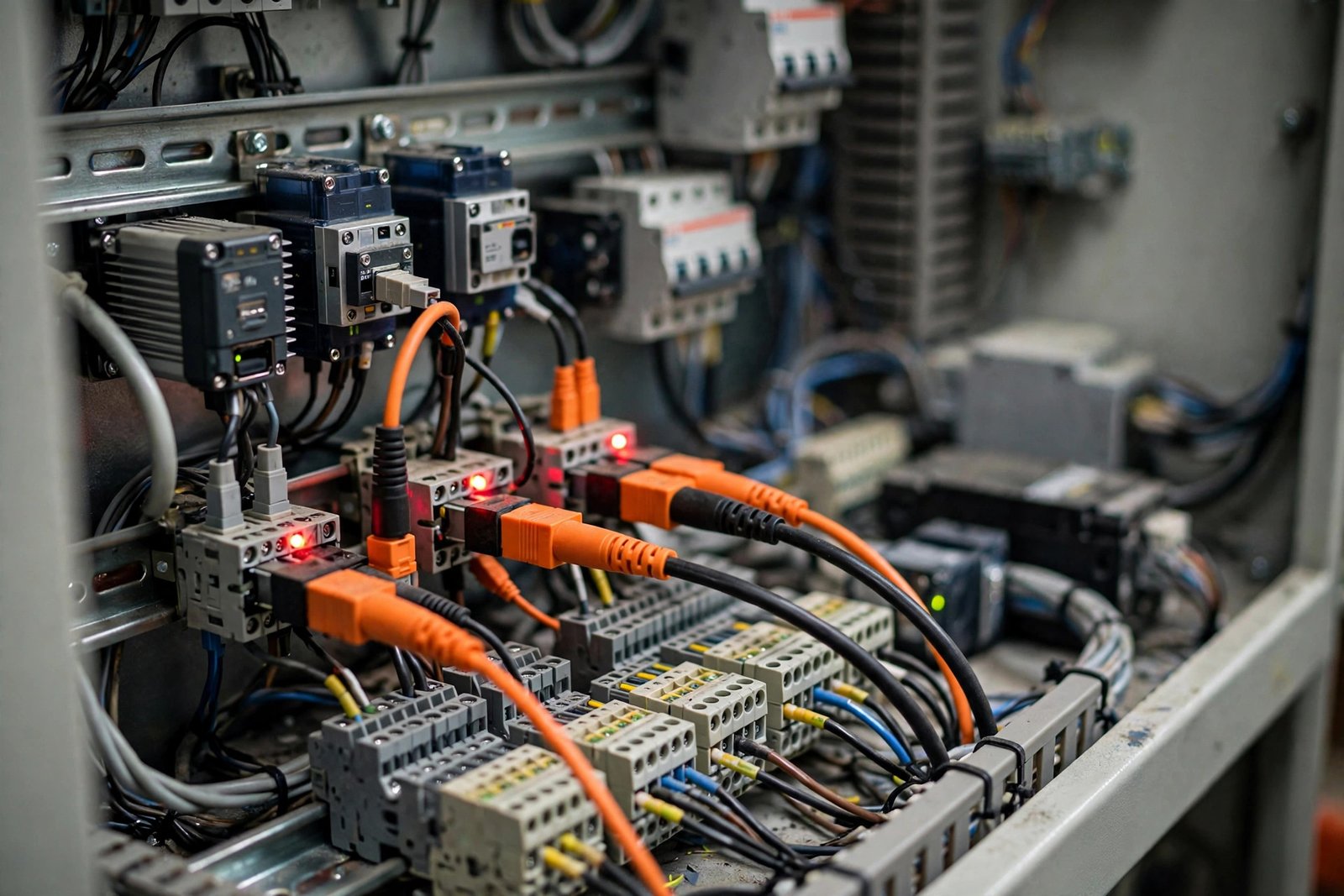
Short answer first. A plastic optical fiber (POF) link is a short link: about 40 metres is the practical ceiling for data, and 5 to 10 metres for digital audio. Put a glass core in the fiber — that is H-PCF, a silica core with a hard polymer cladding — and the same kind of LED link runs 800 to 1,000 metres. Nothing about the connectors or the working principle changes. What changes is how much light the fiber eats per metre.
This matters because the two fibers sit side by side in the same catalogues, often with the same connector on the end. A TOCP200 assembly and a CF-2071 assembly both plug into Toshiba-style F07 ports. Pick by habit and you either overspend on a 3-metre link or watch a 60-metre link fail its loss budget.
The maths that sets the limit
Standard 1 mm POF attenuates about 0.22 dB per metre at 660 nm (Avago’s figure for its standard-grade cable; the extra-low-loss grade is 0.19 dB/m). That sounds like nothing until you multiply it out:
- 10 m of POF: ≈ 2.2 dB gone
- 40 m of POF: ≈ 8.8 dB gone
- 100 m of POF: ≈ 22 dB gone — more than most LED transmitters can spare
Every link has a budget: the gap between what the transmitter launches and what the receiver still recognises. Once fiber loss alone eats the whole budget, no connector quality will save the link. That is why Toshiba rates its all-plastic (APF) assemblies at up to 40 m for data modules, and its audio modules at 5 m, or 10 m for the long-distance versions. The fiber is not fragile or badly made. Plastic simply absorbs and scatters more light than glass, metre after metre.
H-PCF attacks exactly that number. The light travels in a 200 µm quartz glass core; only the cladding is polymer (230 µm overall). Glass-core loss per metre is a small fraction of POF’s, so distance stops being the binding constraint and the electronics take over as the limit instead.
Distance is a system number, not a cable number
Here is the part buyers miss: the metre rating on a cable assembly is really a rating of the cable plus the modules at both ends.
Take Toshiba’s TODX270 duplex transceiver. With PCF cable (TOCP200Q/X) Toshiba rates it to 1,000 m. With Sumitomo CF-2071 H-PCF assemblies, the same module is rated to 800 m. Same transmitter, same receiver, two different ceilings — because the receiver’s sensitivity and the fiber’s loss meet at different points. Toshiba’s application circuit even changes the LED drive resistor by distance band (5.1 kΩ up to 350 m, 510 Ω for the 700–1,000 m stretch) to put more light into longer runs.
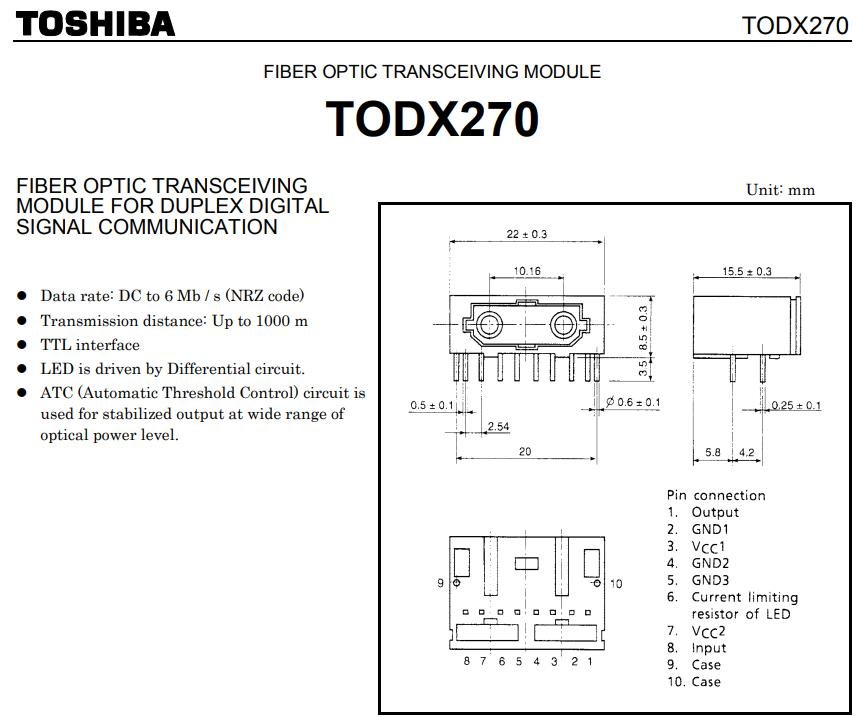
The reverse is also true. A better module stretches a given fiber: Toshiba’s 190-series modules widened the dynamic range by 6 dB over the 170 series, which is 6 dB of extra loss the link can tolerate. When a link misbehaves, the fix is sometimes the module, not the cable.
So read distance claims as system claims. “This fiber does 1 km” means “with the modules it was tested with, at the data rate it was tested at.”
Termination: the workday difference
POF is forgiving to terminate. Cut it, polish the end (a fine polish with 3 µm film is worth roughly 2 dB of coupling versus a coarse finish alone, per Avago), or use crimpless snap connectors and skip the polishing entirely. Inside one cabinet, that speed is the whole point.
H-PCF asks for one more skill: crimp and cleave. The connector is crimped onto the 200/230 µm cable and the glass core is cleaved flush at the ferrule face — no epoxy, no curing oven, no polishing. OFS rates its V-Pin version of this at under two minutes per connector. The cleave quality decides the loss, which is why proper kits include a microscope for end-face inspection and why a loss test after assembly is standard practice, not paranoia.
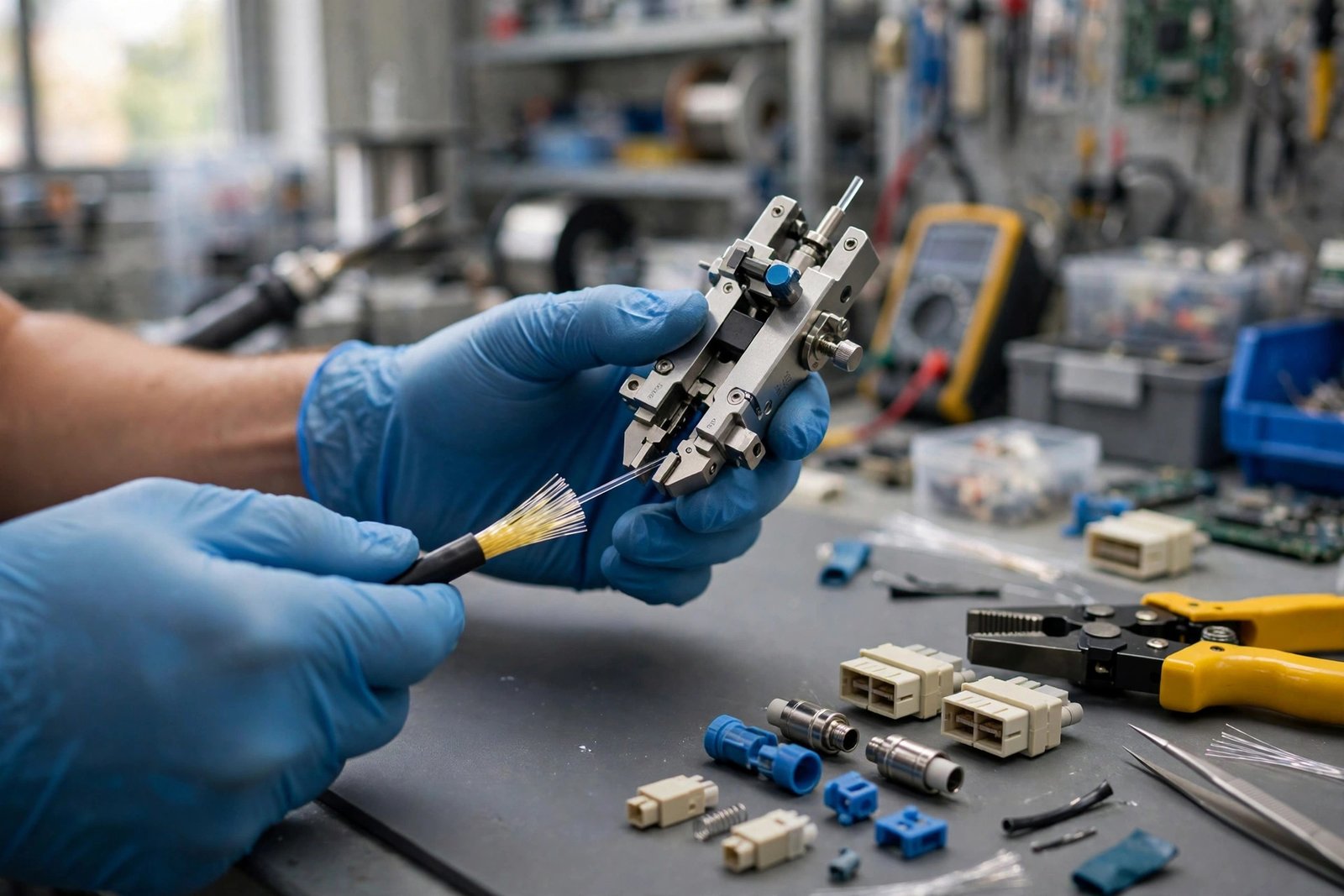
Neither fiber wants to be treated like copper wire. Keep installation bends gentle — Toshiba’s guidance is a working bend radius of 6 to 10 times the fiber’s minimum — and pull connectors, not cords, when you unplug them.
So which one for your link?
Inside one machine or one cabinet (up to ~40 m): POF. Servo drive links, controller-to-I/O runs, board-to-board connections. Cheap, fast to terminate, and the distance ceiling never comes into play. This is TOCP200 territory.
Across the plant, between buildings, or anywhere past 50 m: H-PCF. Factory-automation LANs linking line controllers and I/O units, surveillance camera runs, platform displays, toll-collection gantries, boiler flame monitoring — the H-PCF application lists are full of jobs that are simply too far apart for plastic. PROFINET installations standardised on 200/230 µm PCF pigtails for the same reason. This is CF-2071 territory.
Both fibers earn their place the same way: the signal travels as light, so there is no EMI pickup, no ground loop, and no conductive path between the two ends. In a cabinet full of servo drives and inverters, that isolation — not the distance — is often the real reason fiber is there at all.
Already have Toshiba TOCP equipment? Stay inside the system: TOCP100/155/200/255 assemblies are the APF versions; the Q/X-suffix versions (TOCP200Q, TOCP200X) are the PCF builds for the long runs. The part number tells you which fiber is inside — that is a topic of its own, and we decode it in the next article.
FAQ
How far can plastic optical fiber transmit?
For data links, about 40 m with standard Toshiba APF assemblies and modules; digital audio links are shorter, typically 5 m (10 m for long-distance versions). The limit is attenuation: roughly 0.22 dB per metre for standard 1 mm POF.
How far can H-PCF transmit?
Up to about 1,000 m as a system figure — Toshiba’s TODX270 transceiver is rated to 1,000 m on PCF cable and 800 m on Sumitomo CF-2071 H-PCF assemblies. The exact ceiling depends on the modules and data rate.
Can I extend a POF link with an adapter or coupler?
Yes, Toshiba’s TOCA adapters join TOCP assemblies, but every joint costs loss (up to 2.0 dB for a TOCA200) and shortens the distance you can still cover. On a link that is already near 40 m, an adapter can push it over budget.
Is H-PCF harder to install than POF?
The tools differ, not the difficulty. POF is cut and polished (or snapped together with crimpless connectors). H-PCF is crimped and cleaved, with an end-face inspection under a microscope. Both are field-terminable; neither needs fusion splicing.
JS TECH manufactures TOCP200 POF assemblies and CF-2071 H-PCF patch cords, in standard and custom lengths. Send your link distance and module model to sales@fevelectronics.com and we will confirm which fiber your link budget needs.
