


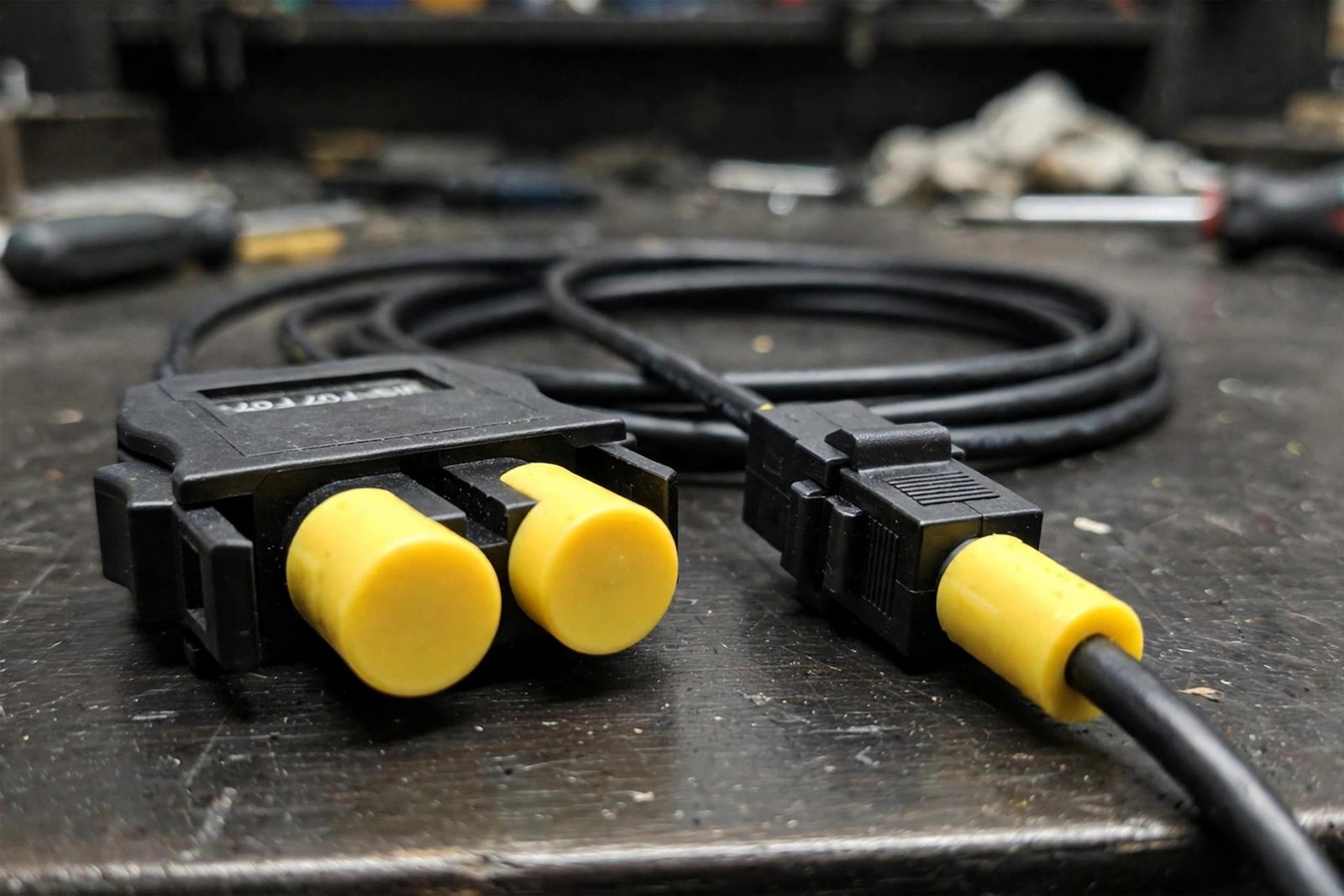
A TOCP part number is not a model name. It is a short specification written in code, and once you know the key you can read off the connector type, the locking style, how the connector was assembled, which fiber is inside, and the length — without opening a datasheet. Toshiba prints the key in its TOSLINK manual; this article walks through it digit by digit and then decodes the four numbers you will meet most often: TOCP100, TOCP155, TOCP200 and TOCP255.
The decoder
A TOCP number is built like this:
TOCP + [cable type] + [lock] + [assembly] + [fiber letter] – [length][unit]
| Position | Values | Meaning |
|---|---|---|
| 1st digit — cable type | 1 | Simplex (one fiber, JIS F05 connector) |
| 1st digit — cable type | 2 | Duplex (two fibers, JIS F07 connector) |
| 2nd digit — lock | 0 | Clip lock |
| 2nd digit — lock | 5 | Snap-in lock |
| 3rd digit — assembly | 0 | Adhesion & polish (connector glued and polished) |
| 3rd digit — assembly | 5 | Simple assembly |
| Fiber letter (optional) | (none) | APF — all-plastic fiber, standard |
| Fiber letter (optional) | P | APF reinforced |
| Fiber letter (optional) | Q | PCF — plastic-clad silica fiber, standard |
| Fiber letter (optional) | X | PCF reinforced |
| Length + unit | e.g. 10M, 50C | Length in metres (M) or centimetres (C) |
Toshiba’s own examples: TOCP100X-100MB is a simplex, clip-lock, glued-and-polished assembly on reinforced PCF fiber, 100 m. TOCP255-50CB is a duplex, snap-in, simple-assembly cable on standard plastic fiber, 50 cm.
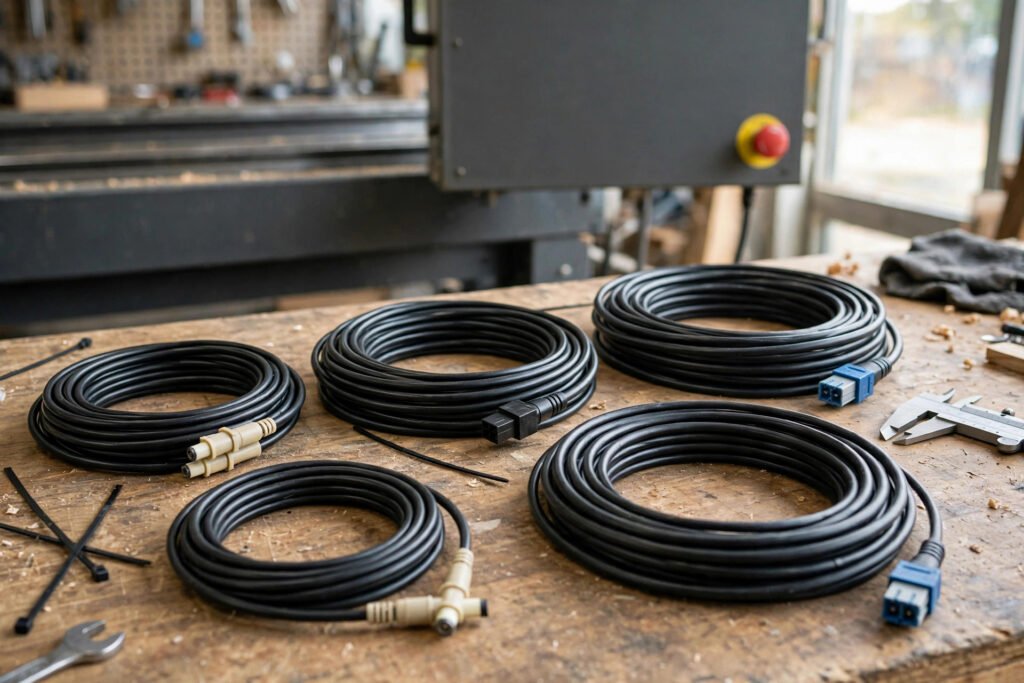
The four common numbers, decoded
TOCP100 — 1: simplex. 0: clip lock. 0: adhesion & polish. No letter: standard all-plastic fiber. The classic single-channel F05 cable for one-way data and audio links inside a machine.
TOCP155 — 1: simplex. 5: snap-in. 5: simple assembly. Same F05 simplex job as the TOCP100, but with the snap-in connector and the simpler assembly method. The two are not interchangeable at the port — check which lock your module takes before you substitute one for the other.
TOCP200 — 2: duplex. 0: clip lock. 0: adhesion & polish. No letter: all-plastic fiber. The duplex F07 workhorse of CNC and servo control: one fiber carries the signal each way, which is what a controller-to-drive conversation needs.
TOCP255 — 2: duplex. 5: snap-in. 5: simple assembly. The duplex counterpart of the 155: F07 connector, snap-in lock, simple assembly, plastic fiber.
The letter that changes the distance
The most expensive mistake in TOCP ordering is ignoring the fiber letter. No letter (or P) means all-plastic fiber, and plastic fiber data links top out around 40 m — attenuation of roughly 0.22 dB per metre sees to that. The Q and X versions carry PCF fiber, a silica-core fiber with plastic cladding, and Toshiba rates complete PCF links at up to 1,000 m with the right modules.
So a TOCP200 and a TOCP200X look alike, plug into the same ports, and differ by an order of magnitude in how far they can run. If a quote for a 100-metre link says TOCP200 with no letter, ask the question before the cable arrives, not after it fails its loss test.
Two more reading habits
The suffix after the dash is length, nothing else. -1M, -10M, -50C and so on. A “B” after the length in Toshiba’s examples is part of their ordering code, not a version or a quality grade.
Don’t decode other brands’ numbers with this key. Sumitomo’s CF numbers (CF-1071, CF-1571, CF-2071) follow a different system for a different fiber — 200/230 µm H-PCF — even though CF and TOCP assemblies often serve the same machines and the CF-2071 is even listed in Toshiba’s own module tables as a compatible cable. Similar shelf, different codebook. If you are cross-referencing a CF assembly to a TOCP one, match the interface (F05/F07), the fiber and the length — not the digits.
FAQ
What is the difference between TOCP200 and TOCP255?
Both are duplex F07 assemblies on plastic fiber. The TOCP200 uses a clip lock and glued-and-polished connectors; the TOCP255 uses a snap-in lock and simple-assembly connectors. Match the lock to your module port.
What does the X in TOCP200X mean?
X means the fiber inside is reinforced PCF (plastic-clad silica) instead of all-plastic fiber. That is the version for long runs — PCF links are rated up to about 1,000 m, versus roughly 40 m for all-plastic TOCP200.
Is TOCP155 the same as TOCP100?
Both are simplex F05 cables, but the 155 is snap-in with simple-assembly connectors and the 100 is clip-lock with glued-and-polished connectors. They fit different ports.
Can I order a TOCP cable in a custom length?
Yes. The length is the last field of the part number, in metres (M) or centimetres (C), and assemblies are routinely made to order — tell your supplier the full code including the fiber letter.
JS TECH manufactures the full TOCP range in Changzhou — TOCP100, TOCP155, TOCP200, TOCP255 and the PCF Q/X versions — in standard and custom lengths. If a part number on your machine’s cable has worn off, send a photo of the connector to sales@fevelectronics.com and we will identify it.
